According to Douglas Adams
Throughout my career as a Digital Educator, I've been less interested in technology itself, than in how it can be applied to inspire cultural change and enhance learning.
According to Douglas Adams in The Salmon of Doubt (2002):
“Anything that is in the world when you’re born is normal and ordinary and is just a natural part of the way the world works.
Anything that's invented between when you’re 15 and 35 is new and exciting and revolutionary and you can probably get a career in it.
Anything invented after you're 35 is against the natural order of things.”
I’m sure we can all smile wryly at this, thinking of particular older individuals we know who are deeply suspicious of technological change. Similarly, the overly simplistic notion of young people as “digital natives” has been prevalent since the 1990s but is still commonly heard today. In reality of course, there are both technology enthusiasts and sceptics in all age groups.
New technology itself doesn’t inspire me, it’s what we do with it that counts.
Sceptical attitudes are not new. Way back in 1565, Conrad Gessner, author of Bibliotheca Universalis, claimed that the printing press was producing too many books - overwhelming scholars and degrading knowledge with an abundance of poor quality work. Initial moral panic and calls to ban the technology were eventually resolved, as society gradually adapted through new norms, institutions and practices such as the development of copyright law.
There are many more such examples. More recently in 1995, Stoll claimed in a Newsweek article that “the truth is no online database will replace your daily newspaper, no CD-ROM can take the place of a competent teacher and no computer network will change the way government works.” That didn’t age well…
Rather than viewing such examples as isolated historical curiosities, they have in fact shaped my own approach to educational innovation. New technology itself doesn’t inspire me, it’s what we do with it that counts. I have long been interested in progressing innovative teaching and learning practices that are not considered “mainstream”. For example, digital literacies have been viewed with suspicion by many staff (and students!) for a number of years, being considered not “academic enough” to grace a serious university education. By Digital literacies I mean the critical knowledge and skills needed to use digital technologies effectively when accessing, creating, evaluating and communicating information in a range of online contexts.
Such scepticism reinforced my conviction that universities needed to help students develop these skills responsibly rather than ignore them. Twenty years ago, I encouraged students to build critical digital literacies by demonstrating their communication skills through blogging, and growing their employability networks by sharing their work on platforms such as Twitter and LinkedIn. There was always a balance to be struck, demonstrating critical, ethical and professional uses of social media on the one hand, while warning against trivial or inauthentic uses on the other. This balance became harder to maintain as fake news, bullying and safety issues gained traction through the late 2010s.
We face similar attitudes and challenges today with Generative AI, which in an educational context I might describe as “digital literacy on steroids”. Amid the predictable calls from some educators to ban it, or to detect and punish those who cheat with it, I recognised the need to focus on the positives in my teaching, while acknowledging its challenges, as I’d done with earlier applications of digital literacies. However, in comparison with earlier technologies, the speed of change is much, much faster.
For example, from a standing start in 2023, assessment on my Digital Transformation modules has evolved each year from: (paraphrasing slightly!)
“Improve some AI generated text on a relevant topic” (2023)
“Reflect on the role GenAI played in the development of your work (2024)
“Create infographics and podcasts to demonstrate your key learning points” (2025)
“Participate in a real time conversation with your educator, supported by a practice session with an AI tutor” (2026)
Each year's assessment worked well for that particular cohort, but required substantial redesign each year as GenAI tools became more capable and more deeply integrated into students' everyday workflows.
Applying the lessons from embedding digital literacies in my modules, I’ve focused on the positives to be gained from responsible, critical use of GenAI tools for learning and employability. I’ve also warned about the dangers of bias, privacy, intellectual property, inequality of access, environmental impact… But is this enough? We are currently emphasising the importance of “human in the loop” to clarify which tasks should benefit from GenAI tools - with human oversight - and which should not, with clear distinctions between them.
Generative AI, which in an educational context I might describe as ‘digital literacy on steroids’.
What will my 2027 modules look like?! Based on this trajectory, the shift from detection to responsible use is heading towards a total rethink of what learning is and how it can be measured. Douglas Adams joked that, for those over the age of 35, any new invention feels unnatural. History suggests something rather different. Every transformative technology has prompted initial scepticism before becoming part of everyday life. Unlike earlier technologies though, the question for educators is no longer if GenAI actually belongs in higher education, but rather can we adapt quickly enough and make the culture change necessary to help our students use it critically and effectively.
--
Gessner, C. (1565) “Bibliotheca Universalis”
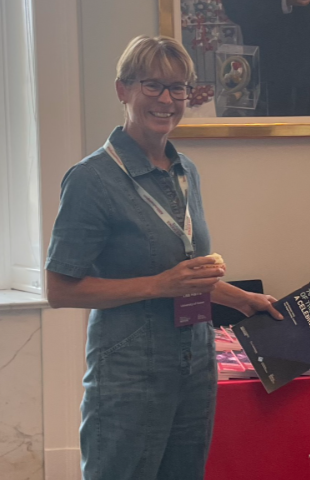
Lisa Harris